Address
304 North Cardinal
St. Dorchester Center, MA 02124
Work Hours
Monday to Friday: 7AM - 7PM
Weekend: 10AM - 5PM
Address
304 North Cardinal
St. Dorchester Center, MA 02124
Work Hours
Monday to Friday: 7AM - 7PM
Weekend: 10AM - 5PM
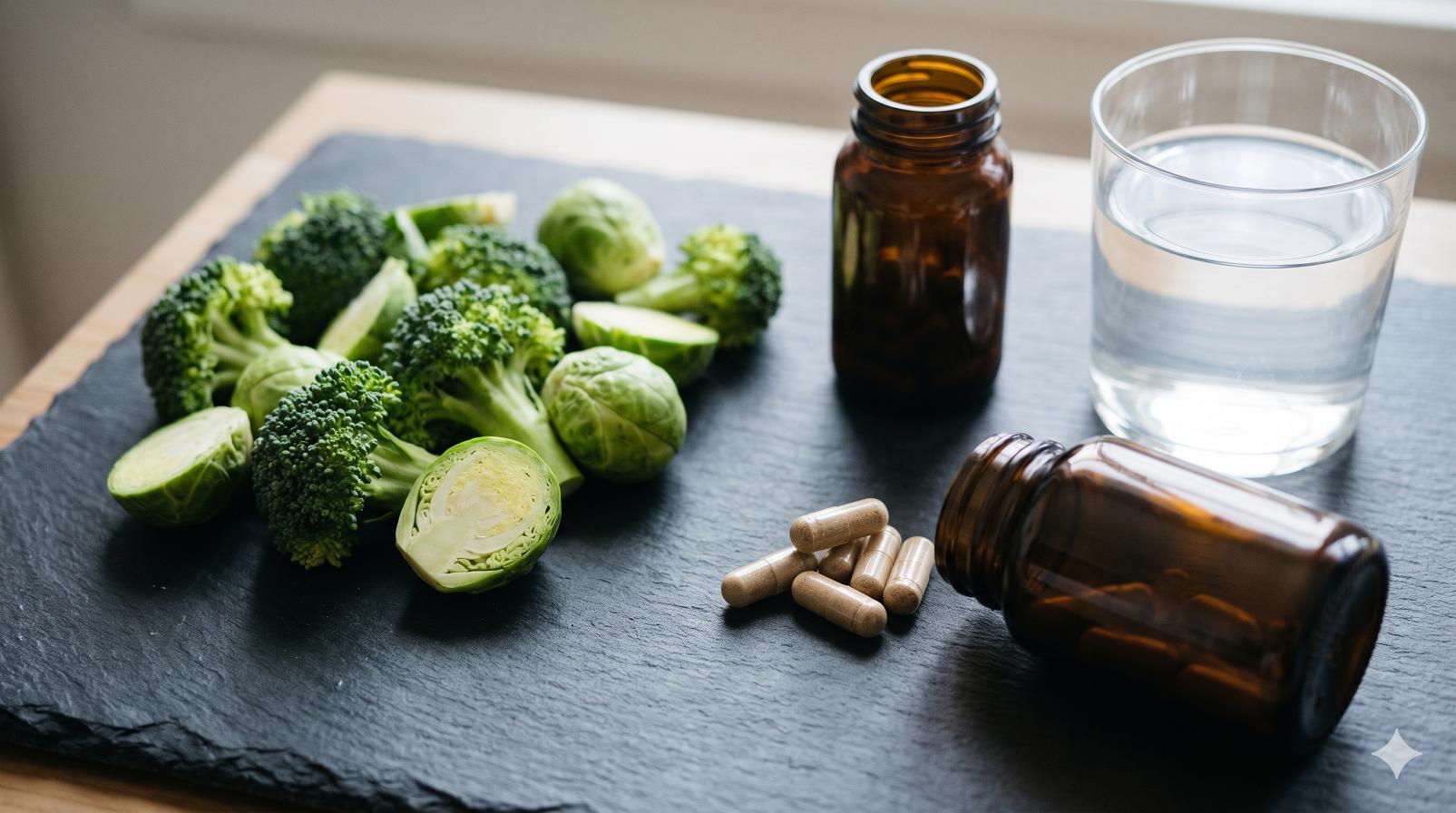
Walk down any supplement aisle or browse men’s health forums, and you will likely encounter 3,3′-diindolylmethane—commonly known as DIM. Marketed as a natural estrogen blocker, testosterone supporter, and prostate protector, DIM has become a staple in fitness stacks and men’s wellness routines.
The compound itself is not a synthetic invention. Your body produces DIM naturally every time you digest cruciferous vegetables like broccoli, Brussels sprouts, kale, and cabbage. Yet the concentrated capsules sold online deliver doses far higher than a typical serving of vegetables, and the marketing claims surrounding them frequently outpace the clinical evidence.
Separating what DIM actually does in the male body from what supplement labels promise requires looking closely at human clinical trials, laboratory studies, and basic endocrinology.
When you eat cruciferous vegetables, you consume a plant compound called indole-3-carbinol (I3C). Once I3C hits the acidic environment of your stomach, it undergoes a chemical reaction and converts into several bioactive metabolites. The most stable and heavily studied of these is 3,3′-diindolylmethane (DIM).
In the body, DIM does not behave like a blunt hormone blocker. Instead, it acts as a modulator of liver enzymes—specifically the cytochrome P450 (CYP) enzyme family—that break down estrogen.
Although estrogen is often labeled a female hormone, men rely on it for bone density, brain function, cardiovascular health, and libido. Men produce estrogen primarily by converting a small portion of their testosterone into estradiol using an enzyme called aromatase. Once estrogen has done its job, the liver breaks it down into different metabolites so it can be excreted.
Research shows that DIM shifts this breakdown process toward a specific pathway:
2-hydroxyestrone (2-OHE1): Often referred to as a weaker, less proliferative estrogen metabolite. DIM increases the production of this pathway.
16-alpha-hydroxyestrone (16α-OHE1): A more potent metabolite associated with stronger estrogenic activity. DIM tends to lower the ratio of this metabolite relative to 2-OHE1.
Because of this shift, DIM is frequently described as supporting “healthy estrogen metabolism.” However, changing how estrogen is metabolized is not the same thing as stopping estrogen production altogether.
Much of the enthusiasm for DIM stems from laboratory (cell culture) and animal studies. While those studies are useful for understanding biological mechanisms, they do not automatically translate to real-world results in humans. Here is how the evidence holds up across the most common reasons men take DIM.
1. Estrogen Balance and “Estrogen Dominance”
Men often turn to DIM hoping to lower high estradiol levels, particularly if they carry excess body fat (fat tissue contains high levels of aromatase) or are undergoing testosterone replacement therapy (TRT).
The evidence: DIM is not a true aromatase inhibitor. Prescription medications like anastrozole directly block the aromatase enzyme from converting testosterone into estrogen. DIM works downstream, altering how existing estrogen is processed in the liver.
While small human studies confirm that DIM supplements can shift urinary estrogen metabolite ratios (increasing the 2-OHE1 to 16α-OHE1 ratio), there is very little clinical trial data showing that DIM reliably lowers total serum estradiol in healthy men or resolves symptoms of high estrogen. Men on TRT who experience elevated estradiol should work with their prescribing physician rather than self-managing with over-the-counter supplements.
2. Testosterone Levels and Muscle Growth
Many supplement brands market DIM as a “free testosterone booster,” arguing that by clearing out excess estrogen, the body will have more available testosterone.
The evidence: No robust human clinical trials demonstrate that DIM increases total or free testosterone levels in men.
In fact, some laboratory research points in a different direction. In vitro studies on human prostate cancer cells have found that DIM can act as a weak androgen receptor antagonist—meaning it can partially block testosterone and dihydrotestosterone (DHT) from binding to androgen receptors. While scientists view this property as potentially useful in slowing hormone-driven prostate cancer cells, it directly contradicts the marketing claim that DIM enhances anabolic or testosterone-driven effects in healthy men. Whether standard oral supplement doses produce this anti-androgenic effect in healthy muscle tissue remains unproven.
3. Prostate Health and Prostate Cancer Research
Prostate health is the area where DIM has the strongest—though still preliminary—human research.
The evidence: Researchers have investigated bioavailable forms of DIM in men with high-grade prostatic intraepithelial neoplasia (HGPIN, a precancerous prostate condition) and castrate-resistant, non-metastatic prostate cancer.
Phase I and II Clinical Trials: Small clinical studies (including trials using microencapsulated formulations like BR-DIM) found that DIM was generally well-tolerated and capable of reaching prostate tissue. In a subset of patients with early-stage or recurrent prostate cancer, researchers observed stabilization of prostate-specific antigen (PSA) levels and reduced androgen receptor activity inside prostate cells.
Benign Prostatic Hyperplasia (BPH): Animal models suggest DIM may reduce inflammation and abnormal cell growth in the prostate, which has sparked interest for enlarged prostate (BPH) management. However, large-scale human clinical trials proving that DIM relieves urinary symptoms of BPH do not yet exist.
The National Cancer Institute and oncology researchers regard DIM as a compound of interest for future study, not an established prevention strategy or treatment for prostate disease. Men with elevated PSA levels, urinary changes, or a prostate cancer diagnosis should never use DIM in place of standard medical care.
4. Weight Loss and Gynecomastia
DIM is frequently promoted online as a natural remedy for stubborn belly fat and gynecomastia (enlarged male breast tissue).
The evidence: There are currently no controlled human trials showing that DIM causes fat loss, improves body composition, or reduces gynecomastia. Gynecomastia is driven by an imbalance between estrogen and androgen activity at the breast tissue level, and once glandular tissue has developed, dietary supplements cannot reverse it. Persistent breast tissue enlargement in men warrants a medical evaluation to rule out underlying endocrine, liver, or medication-related causes.
| Health Goal | Common Marketing Claim | Current Level of Human Evidence |
| Estrogen Metabolism | Blocks estrogen production | Moderate for metabolite shifts. Alters liver breakdown of estrogen; does not act as a true aromatase inhibitor. |
| Testosterone Support | Boosts free and total testosterone | None. No human trials show testosterone increases; cell studies suggest mild anti-androgen activity. |
| Prostate Health | Prevents BPH and prostate cancer | Preliminary. Small Phase I/II trials show tissue uptake and cellular changes; no Phase III proof of prevention or cure. |
| Weight Loss / Fat Burning | Targets hormonal belly fat | None. No clinical trials demonstrate fat loss in men. |
| Gynecomastia | Shrinks male breast tissue | None. No clinical evidence supports its use for reversing breast tissue growth. |
If you are considering DIM, how the compound is delivered matters as much as the dose.
Pure crystalline DIM is notoriously difficult for the human digestive tract to absorb. Because of this poor bioavailability, most human clinical trials have used specialized, microencapsulated formulations (often listed as BioResponse DIM or BR-DIM) or paired DIM with absorption enhancers like black pepper extract (piperine).
There is no established Recommended Dietary Allowance (RDA) or standardized clinical dose for DIM. Commercial supplements typically contain 100 mg to 300 mg per day. In prostate clinical trials, researchers have tested higher doses under medical supervision, but taking high doses without guidance increases the likelihood of side effects without proven added benefit.
You can stimulate your body’s natural DIM production by eating cruciferous vegetables such as broccoli, cauliflower, cabbage, bok choy, and Brussels sprouts. While you would need to eat several pounds of raw cruciferous vegetables daily to match the concentrated dose in a 200 mg capsule, whole vegetables offer something isolated supplements do not: fiber, vitamins, minerals, and other protective phytochemicals like sulforaphane. Large observational studies consistently link regular cruciferous vegetable intake with better cardiovascular and long-term metabolic health—outcomes that isolated DIM capsules have not yet replicated in clinical trials.
For most healthy adults, short-term use of standard DIM doses appears to be relatively well-tolerated, though long-term safety data in humans is limited.
Common side effects include:
Darkened urine: A harmless brownish or amber tint caused by DIM metabolites being excreted.
Headaches: Often reported during the first week of use, particularly at higher doses.
Digestive discomfort: Gas, bloating, nausea, or changes in bowel habits.
Hormonal considerations: Because DIM alters estrogen metabolism, taking it when your estrogen levels are already normal or low may cause unwanted effects. Men need adequate estradiol for joint lubrication, mood stability, and sexual function; disrupting that balance unnecessarily can backfire.
Medication interactions: This is the most overlooked risk of DIM. Because DIM activates cytochrome P450 liver enzymes (including CYP1A2 and CYP3A4), it can accelerate the rate at which your liver breaks down certain prescription drugs. This may lower blood levels of medications metabolized by those pathways, potentially making them less effective.
Consult a doctor or pharmacist before taking DIM if you use prescription medications, undergo hormone therapy (including TRT), or have a history of hormone-sensitive conditions.
There is no human clinical evidence proving that standard doses of DIM lower blood testosterone levels. However, because laboratory studies show DIM can interfere with androgen receptor signaling in prostate cells, men looking to maximize testosterone activity should be cautious about assuming DIM is a testosterone booster.
Changes in urinary estrogen metabolites can appear within a few weeks of consistent supplementation, according to small human studies. However, because there is no proven clinical timeline for symptom relief in men, anyone taking it for a specific health concern should discuss measurable goals and blood work with a healthcare provider.
Some men on TRT take DIM in hopes of managing elevated estradiol without prescription aromatase inhibitors. While it is generally not acutely dangerous, DIM is not a reliable substitute for medically managed hormone control, and its effects on serum estradiol are unpredictable. Always check with your prescribing clinician before adding DIM to a TRT protocol.
DIM produces colored metabolites as your body processes and excretes it. A harmless darkening of the urine—often amber, orange, or brownish—is one of the most common effects. Drinking adequate water can dilute the color, though if dark urine persists after stopping the supplement or is accompanied by pain or yellowing of the skin, seek medical evaluation.
For general health, eating cruciferous vegetables regularly is the safer, better-supported choice. Whole vegetables deliver I3C alongside fiber and other beneficial compounds without the concentrated drug-interaction risks of high-dose supplements. Supplements are best reserved for specific, targeted use discussed with a healthcare professional.
DIM is a biologically active compound with a plausible mechanism for influencing estrogen metabolism and early, intriguing data in prostate cancer research. What it is not is a proven testosterone booster, fat burner, or over-the-counter replacement for prescription hormone therapies.
If you are experiencing symptoms you suspect are related to hormone imbalance—such as persistent fatigue, low libido, mood changes, or breast tissue enlargement—the most effective first step is a blood panel and a conversation with a physician, not a bottle of capsules. Understanding your actual hormone levels will always serve you better than guessing with a supplement.
Medical Disclaimer: This article is for educational and informational purposes only and does not constitute medical advice, diagnosis, or treatment. Dietary supplements are not regulated by the FDA for safety and efficacy in the same manner as prescription drugs. Always consult a qualified healthcare provider before starting any new supplement, especially if you have an existing medical condition or take prescription medications.